LSAT Wrong Answer Journal: What to Record and How to Use ItLSAT Wrong Answer Journal: What to Record and How to Use It
By Bob Verini
An LSAT wrong answer journal, also called an LSAT error log or wrong answer log, is a simple way to keep track of the questions you miss during practice. You record the PrepTest, section, question number, question type, the answer you chose, and the correct answer. Keeping that information organized makes it easier to find questions again, see which question types you miss repeatedly, and decide what to review. It also gives an LSAT tutor such as Bob Verini a useful starting point when helping you address difficulties in your preparation.
What Is an LSAT Wrong Answer Journal?
An LSAT wrong answer journal is an organized log of missed questions.
After checking your answers, you add each missed question to the journal. Instead of scattering that information across different notebooks, screenshots, or practice-test results, you keep a searchable record in one place.
For example, you might record that you missed a Necessary Assumption question, selected B, and the correct answer was D. The entry preserves that information so you can return to the question later.
As your journal grows, you can look across several practice sessions rather than relying on your memory of the most recent test.
Why Keeping an Error Log Matters
A practice-test score tells you how you performed overall. A wrong answer journal lets you examine the individual questions behind that score.
You might discover that Necessary Assumption questions account for several of your recent misses. You might notice that you repeatedly miss Reading Comprehension inference questions, or that missed questions tend to appear near the end of your sections.
Those observations give you something specific to investigate during review.
The journal also makes it easier to revisit older questions. Without a log, finding a question you remember struggling with two weeks ago can turn into an unnecessary search through previous tests.
With the question references recorded, you can go directly to the material you want to review.
The Easiest Way to Start: Use a Free LSAT Wrong Answer Journal
The easiest way to keep everything organized is to use LSAT Wrong Answer Journal. The service is 100% free, with no ads or paywall.
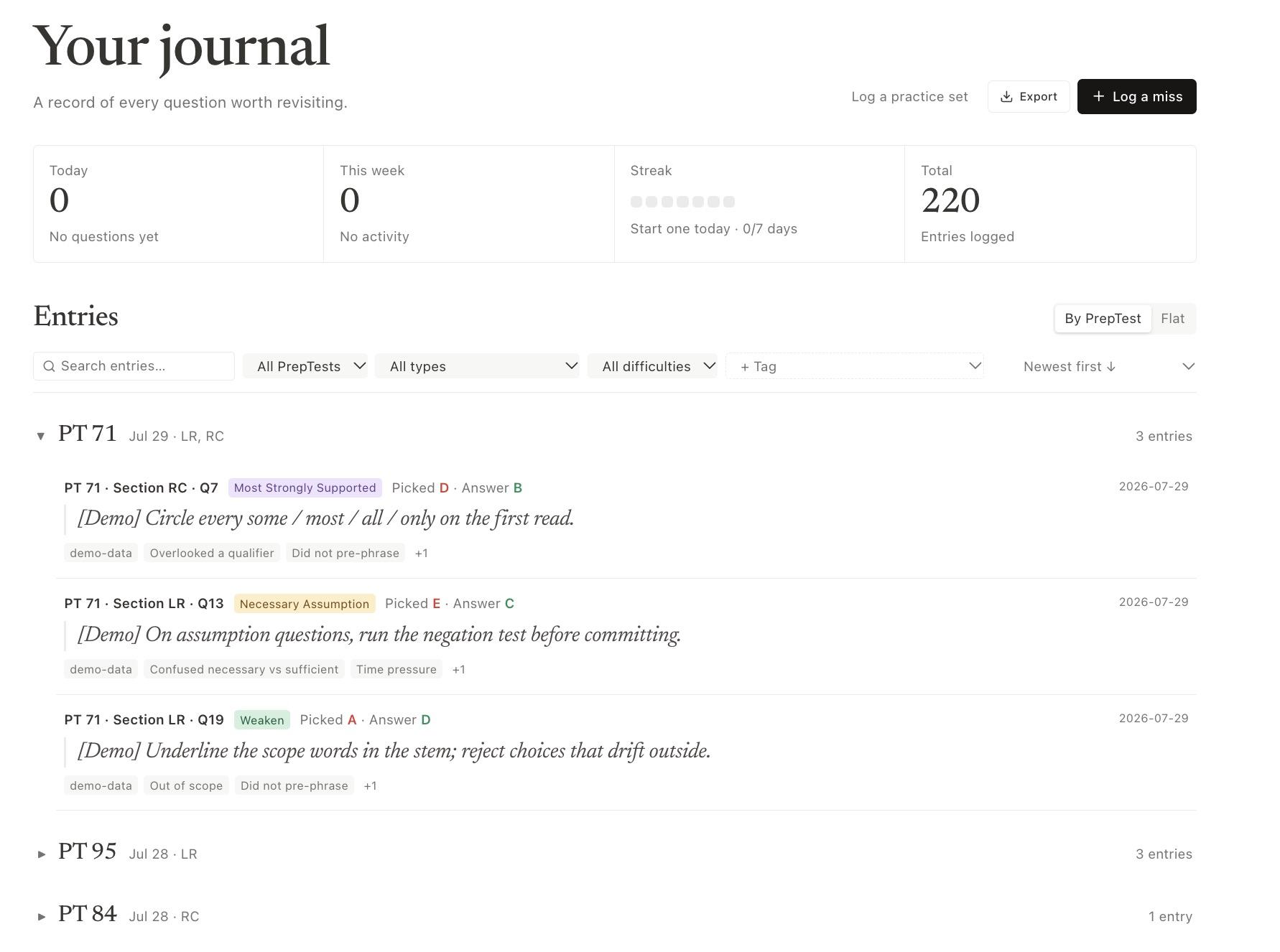
Its layout is convenient and designed specifically for LSAT practice. You can enter your question details, record your answer and the correct answer, and keep your entries together in an organized journal.
For this task, the layout is much easier to use than creating and maintaining your own Excel spreadsheet. You do not need to build a template, set up columns, adjust formatting, or create your own system for finding entries.
The service lets you group entries by PrepTest and search or filter them by question type and difficulty. That makes it convenient to pull up a particular test or collect questions of the same type for review.
You can keep the process simple: log the question, record the two answers, and return to your studying.
What to Record for Each Missed Question
Your journal needs enough information to identify the question and preserve your result.
PrepTest Number
Record which PrepTest contains the question. Use the numbering shown in the materials you are working from so you can locate it again.
Section and Question Number
Include the section and question number. The PrepTest number alone is not enough to identify a particular question.
Question Type
Record the question type, such as Necessary Assumption, Strengthen, Weaken, Flaw, or Reading Comprehension Inference.
Using consistent labels makes it easier to group similar questions later.
The Answer You Chose
Record your original answer before you forget it. Knowing which choice you selected will be useful when you revisit the question independently or discuss it with a tutor.
The Correct Answer
Record the credited answer alongside your selection.
That gives you the basic entry: where the question is, what kind of question it is, what you selected, and which answer was correct.
When to Update Your Journal
Update your journal after checking a practice set, section, or full PrepTest.
Doing it consistently keeps the record complete. If you log questions only after particularly frustrating tests, your journal will leave out other practice sessions that could be useful to review.
You do not need to turn logging into a separate writing assignment. Enter the identifying details and answer choices, then move on.
Be consistent about how you label question types and test references. Small differences in naming can make related entries harder to find together.
How to Use Your Journal During Review
Start by looking at which question types appear repeatedly across your recent entries.
If you have missed several Flaw questions, pull those entries together and return to the original questions. If Reading Comprehension inference questions keep appearing, collect those for a focused review session.
The log helps you select the material. The review happens when you reopen the questions and work through them.
You can also revisit questions from an earlier PrepTest after some time has passed. Keep the recorded correct answer out of view while attempting the question again, then check your result.
Follow focused practice with a mixed set or timed section. This gives you an opportunity to apply what you have practiced when similar questions appear among other question types.
Continue logging new misses so you have an ongoing record of your work.
How a Wrong Answer Journal Can Help an LSAT Tutor
If you decide to work with an LSAT tutor, you can send Bob Verini your error log before a session. It gives him a list of specific questions to examine and shows which question types have caused repeated difficulty.
That is a much more useful starting point than trying to remember which questions bothered you or saying that Logical Reasoning generally feels difficult.
Bob can return to those questions with you, examine the answer choices you selected, and ask you to explain how you approached them. Working through the original questions together helps him identify what needs attention and focus the tutoring accordingly.
With more than 45 years of LSAT teaching experience and over 10,000 students taught, Bob Verini has extensive experience helping students work through recurring difficulties. An organized error log gives him concrete material from your own preparation to use in that process.
Keep your journal current and bring the relevant questions to your review sessions. A simple, organized record makes it easier to spend your study time on the material that needs attention.
Ready to Find Out Where You Stand?
I offer a free initial consultation for new students. We'll look at your current scores, discuss your target schools and timeline, and figure out whether working together makes sense.
Schedule a Free Consultation